Tuesday, January 6, 2015

FlyersRights.org
Passengers Suffer as Airlines Ramp Up Outsourcing
January 6, 2015

Increasingly, airline workers at US airports aren't employees of the carriers they represent. 
A photo of the United Express bagroom this week. Behind the scenes as to why passengers may not be getting their bags on time. (The Denver Post | 12/31/14)

Never was this more evident than at the baggage carousel over the holiday season.

United Airlines' ramp operations which handles bags at Denver International Airport were a good example of a system completely falling apart last week, with some passengers waiting hours to be reunited with their checked luggage.

Problems continue on today with news of hour and fifteen minute delays for checked bags.

Some pictures even show luggage being left on the tarmac overnight. 

From the looks of things, United's decision to change ground handling at DEN
 has turned into a major fiasco. 

Minimize labor cost. Increase shareholder value. Maximize ROI.

This all began back in September, when United Airlines announced its contract with SkyWest Airlines for its United Express below-wing ground baggage handling at DEN would end, resulting in job losses of about 650 Denver workers.

SkyWest, which held the contract for nine years, was replaced Dec. 4by Simplicity Ground, a subsidiary of United Kingdom-based Menzies Aviation, which has been fined for cutting corners and unsafe working conditions. 

United previously paid these workers between $12 to $24 per hour while the new vendor pays around $8 to $9 per hour, without benefits.

In announcing the cuts, a United spokesperson said the airline needed to keep its costs "competitive."
This latest reduction is just another assault by the airlines on the traveling public. Customers pay the same prices and same high bag fees yet must endure diminished airline service.
 
Lowering Expectations
 
TWU 555 Indianapolis representative Shaun Burris protests with other Southwest Airlines employees at the Indianapolis International Airport, Tuesday, December 16, 2014. Members of the Transit Workers Union (TWU) 555, including those who work outside on the ramp, operations, cargo and provisioning, picketed at the airport saying they haven't had a contract in over 3 1/2 years. (Photo: Kelly Wilkinson/The Star)
Southwest Airlines employees protest at the Indianapolis International Airport, Dec. 16, 2014. Members of the Transit Workers Union, including those who work outside on the ramp, operations, cargo and provisioning, picketed at the airport saying they haven't had a contract in over 3 1/2 years. 
Workers also staged informational picketing at airports in Dallas; Denver; Los Angeles/Ontario; Buffalo, New York; Cleveland; Detroit; Fort Myers, Fla.; Indianapolis; Milwaukee; Minneapolis; Pittsburgh; San Diego; San Jose, Calif.; and Seattle. (Photo: Kelly Wilkinson/The Star)
As FlyersRights has been reporting over the past year, United's action is part of a larger trend by the airlines and airports to hire outside vendors to replace employees.

Currently a large portion of check-in-agents at US airports do not work for the companies they are servicing.

It's common for the same employee at smaller airports to represent several different airlines.

Delta and Alaska Airlines are among the carriers outsourcing a large portion of their work.

Earlier this year Delta contracted out the jobs of 741 workers at the Detroit Metropolitan Airport to vendors paying near minimum wages.  

Race To The Bottom

The question is, when you're United Airlines and consistently at the bottom of customer satisfaction ratings, why do this?

Instead of improving customer service, the aircraft, the food, or the on-time arrivals - United decides to cut costs.

Your Montreal Convention Rights

For nearly all international flights under the Montreal Convention of 1999, Airlines are liable for damages caused by delay in the transporting of passengers for up to $6,000, unless the airline proves that it took all reasonable measures to prevent the damage caused by delay or that it was impossible for them to take such measures.

No airline is permitted by contract to assert lower liability limits for international air travel, and any such contract terms are void.
 
Paul Hudson, FlyersRights.org noted, "Airlines and even the US DOT regularly manage to conceal this important right from passengers."
Epically Miserable:

Angry, Hungry SFO-Bound Passengers Left Inside Plane Stuck On Tarmac For 12+ Hours In Abu Dhabi 

Here's a flashback to what air travel was like before FlyersRights. Imagine being stuck in a plane for more than a day.
 This photo, provided by passenger Rithvik Reddy, shows a crew member speaking to the fliers

That was the nightmare for passengers in Abu Dhabi trying to make it to San Francisco last Saturday.

Etihad Airways Flight 183 was delayed on the tarmac for over 12 hours after fog forced the temporary closure of Abu Dhabi Airport on Saturday.

That, on top of the 16-hour flight to SFO, made passengers furious. All told, they spent more than 28 hours on the plane, AP reported.

The airline wouldn't allow passengers to get off or give them information, so hundreds took to social media to vent that they were hungry, sleep deprived, and never flying with the airline again.

It was their only option because the United Arab Emirates has no 3-Hour Tarmac Delay Rule, like in the US.

When the flight finally landed at SFO around 6:30 p.m. Saturday, one passenger, Vinay Ramakrishna said, "Out of every airline, this has been the worst experience in my life. There's no sanitation, they're out of water, out of tissues, out of apples, out of chocolates!"

If this had happened in the US, Etihad would be facing steep fines. As high as $27,500 per passenger after 3 hours on the tarmac for domestic flights; four hours for international flights. 

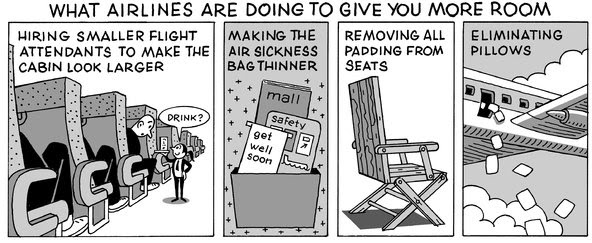
Cartoon Of The Week:


Video of the WeekWorst Class
Flying Coach - Movie Trailer

 
Sign our FlyersRights Petition 
for a Passenger Bill of Rights 2.0!


Kate Hanni, founder 
with Paul Hudson, President

Getting on a Plane? 
Put This Number in Your Phone:
Send comments and tips to KendallCreighton or Twitter KendallFlyers.

Tuesday, December 30, 2014

FlyersRights.org

 Last Chance for 2014 Tax Deductions

December 30, 2014
As the saying goes, 'tis better to give than receive.

Here's another way to get rid of those pesky frequent-flyer miles. Well, it's not the miles that are pesky, it's those warnings that your miles are going to expire due to inactivity that get irritating.

This year, instead of trading in a few hundred miles for magazine subscriptions - gift your miles to FlyersRights!  

Pledge to donate your miles to our volunteer staffers at FlyersRights who need to travel for meetings, etc.
  
Alternatively, FlyersRights will accept miles into our matching  frequent-flyer account (an airline fee may apply).

Please contact FlyersRights' president Paul Hudson at Paul@flyersrights.org to donate.

Thank you.

Double Your Tax Benefits By Donating Appreciated Stock

If you traditionally give cash at year end, consider this: higher tax rates and strong stock returns make donating stock an especially attractive tax-saving move.

Many stocks in the last year have posted strong returns. And with higher tax rates, you face paying increased capital gains tax on their investments if sold.

As for gifting appreciated stock, the donor just has to transfer it to the
FlyersRights.org account and will receive a tax deduction based on the present market value rather than what they paid for it.  

Making a donation of stock can double your tax benefit. If you donate an appreciated security, you will avoid paying the capital gain on the sale. In addition, the gifted stock allows you to deduct the value of the donation on your tax return.

FlyersRights.org is equipped and ready to receive your stock donations. Just tell your broker you wish to donate stock to FlyersRights.org.

For account number contact Paul Hudson at (800) 662-1859.

FlyersRights Education Fund is a 501(c)(3) non-profit organization
Federal Tax ID 27-4519068 

Disclaimer: it is wise to consult with your tax advisor when contemplating gifting money or property. 
2014 - A Grim Year For Modern Aviation  

The world was stunned when MH370 vanished back in March.

Now, over the weekend, another plane was lost.

Nearly 72 hours later, Indonesian rescuers are pulling bodies and wreckage from the sea off the coast of Borneo of AirAsia flight QZ850.

Again, the world asks, how is it possible that in 2014 we couldn't immediately locate an aircraft when it lost contact with air traffic control?

On Monday, FlyersRights president Paul Hudson stressed to Reuters, "It should be impossible for an airliner to go missing" in an age when people can track their phones and cars to within a few feet.

Better tracking and real-time flight-data monitoring became urgent issues after Malaysian Airlines flight MH370 went missing in March with 239 people on board, possibly flying for hours on autopilot as a "ghost plane" until its fuel ran out. It is thought to have crashed in a remote part of the Indian Ocean.

Its disappearance prompted the International Civil Aviation Organization, a United Nations agency, to set up a task force led by the International Air Transport Association on tracking systems.

IATA's working group, representing airlines, pilots, air traffic controllers and airplane makers, already has agreed aircraft should be tracked to the nearest nautical mile.


Air Disasters Outside of the US

2014 has seen crashes in other parts of the world, and it needs to be figured out what is being done differently.

Here in the US, the last fatal accident involving a domestic commercial flight was Colgan Air Flight 3407, which crashed near Buffalo, killing 50 in Feburary 2009.

Is this the result of good US government? Appropriate, proactive protection and regulation?

It's been well documented that the the FAA continues to view its main task as promotion of the Airline Industry rather than as the lead advocate for commercial aviation safety.

And the airlines have a history of fighting requirements because they're "expensive", so the FAA - at best - makes recommendations or makes reporting voluntary.

As the world gets smaller, more Americans are flying outside of the country.  In much of the rest of the world, our level of pilot and engineer training, flight hours and personal commitment to safety does not exist, says aviation expert Chris Yates to DW.  

This year's Malaysian air disasters point to disturbing trends, reportsBloomberg Businessweek, that raise question of whether flying in peninsular Southeast Asia is completely safe.

The air market in the region has embraced low-cost carriers, leading to a proliferation of flights throughout Southeast Asia, stretching air traffic controllers, and possibly allowing some airlines to expand too rapidly.

Indonesian carriers, air traffic controllers, and Indonesian airspace in general  have become notorious for weak safety regulations, concluded Bloomberg.  

Year End Mystery

Its that time of the year again, so before we start planning our events of the new year let's take the time to look back at what has happened over the past 365 days:

Ethiopian Airlines Flight 702 (Hijacking) - no deaths.
Malaysia Ailines Flight 370 (Unknown) - 239 deaths.
Malaysia Airlines Flight 17 (Shot down over Eastern Ukraine) - 283
Air Algerie Flight 5017 (Crashed in Mali - Investigation Continues)- 116 deaths.
TransAsia Airways Flight 222 (Crashed Into buildings - Investgation Continues) - 48 deaths.
AirAsia Flight 8501 (crashed off the coast of Borneo) -162 deaths.

What is extraordinary is the high percentage of accidents when at cruising altitude, generally accepted the safest part of any flight.    

Corrections

In last week's newsletter, we listed a wrong college where our summer interns hailed from. They are American University and Georgetown University - not George Washington University.

In last week's letter response on non-refundable tickets, we should have clarified that non-refundable tickes have become non-usable by airlines imposing very high change fees. 

There are two exceptions: You can get a refund on a nonrefundable ticket if you cancel within 24 hours of making the reservation or if the airline cancels or excessively delays the flight and you do not take the flight.

Kate Hanni, founder 
with Paul Hudson, President
Sign our FlyersRights Petition 
for a Passenger Bill of Rights 2.0!


Getting on a Plane? 
Put This Number in Your Phone:
Send comments to the editor, KendallCreighton or @KendallFlyers

Tuesday, December 23, 2014


FlyersRights.org
  Year View Mirror
December 23, 2014


With Christmas Eve tomorrow, we'd like to wish you a Merry Christmas and Happy Holidays - all the best for a great new year and good health and happiness.

Thank you for coming aboard FlyersRights this year and subscribing to our newsletters. You clearly share our commitment to renewing the joy of travel and improving passenger rights. I hope you will consider supporting us in 2014.

With so much accomplished and much to anticipate, we want to thank you for backing FlyersRights this year and expressing interest in our mission.

Give A Little, Get A Lot

It is our hope that you become more involved in 2015. We rely on passionate and committed individuals like you to advance the success of FlyersRights.

Thank you for considering a tax-deductable, annual contribution this month online.

Should you have any questions, please contact Paul Hudson, FlyersRights president, at Paul@FlyersRights.org.

Thank you again and we wish you the happiest of holidays.


Monday, December 22, 2014


December 23, 2014

It's been an extraordinary year for FlyersRights. A period of growth, excitement, and renewed commitment to our expanded mission. 

We have discovered how many partners and friends we have across the country. Thank you for your support!

FlyersRights was founded as the Coalition For An Airline Passengers Bill Of Rights in 2006, with the primary mission of  organizing other passengers to pass a Passenger Rights bill ending lengthy tarmac delays.

The bill allowed passengers the option of getting off delayed planes after 3 hours on the ground, and required airlines to provide adequate food, water, temperature controls, ventilation and working toilets to accommodate a 3-hour delay.

We achieved this initial legislative goal with the enactment in 2012 with bipartisan Boxer-Snowe Bill of Rights. But much more needs to be done to restore the rights of passengers who are being squeezed physically and financially as never before.

Prior to FlyersRights, there was one place Americans could be assured of having almost no rights, no freedom of movement, no fresh air, no food or water, or even working toilets - that was on the airlines and runways of the nation's airports. 

Remember back to what holiday air travel was like five years ago? Bad weather routinely stranded passengers on hundreds of flights that idled on tarmacs, neither taking off nor returning to the terminal, for five, seven, even 12 hours and more.

An average of 1,500 domestic flights in each of the worst years, 2007 and 2008, were stranded on tarmacs for three hours or longer. In contrast to this year, where virtually zero lengthy tarmac delays were reported by the Transportation Department.

Still, the federal government has done pitifully little to protect air travelers, from the airlines re-engineering seating be as tight as possible to rubber-stamping megamergers that have significantly reduced competition, meaning higher prices and jam-packed planes, to allowing price gouging.

With the void in leadership from Washington, FlyersRights stepped in. We opened a staffed office on Capitol Hill in May, the first time since 2002 that passengers had such a presence in DC. We have succeeded brilliantly in carrying out that charge. 

Our summer internship program brought together smart minds from the law departments of George Washington University and Georgetown University, who helped draft the legislation.

Stories We Missed!
A Sensory Deprivation Helmet Zones Out Coach Passengers?


'

Wow, how did we miss this one?!

Back in September, Airbus filed a patent application for helmets attached to the headrests of coach seats that almost completely covers the passenger's head.

Here's Airbus's statement of the problem their space helmet is designed to solve:
During aircraft flights, certain passengers have periods when they are bored either during a wait phase preceding take-off or following landing or during a cruise phase. Moreover, it is known that aircraft flights generate stress for certain passengers.
Translation: Flying in coach is an awful experience, you'll forget all about it with a helmet on.
This solution, as envisioned in the patent application, is to envelop passengers' heads in virtual-reality helmets, that distract attention from the too-tight seating with piped-in sounds, images, even smells. Or by blotting out consciousness altogether with a cocktail of white noise and deep-space darkness.

Just like how a hood calms a restless bird, and blinkers soothe on a spooky horse - we agitated passengers will be lulled into comatose, sardine cargo.

JetBlue CEO: 
Price Gouging Is A "Rude" Fact Of Air Travel 
Back in June, Dave Barger, the CEO of JetBlue, acknowledged a fact that many airlines would prefer their customers not think about.
For both the company and consumers, Barger told "CBS This Morning," a good flying experience is "about efficiency, it's about being productive. 
Barger said some of the additional and inflated fees airlines tack on to the cost of flying are "rude, when you really look at it." 
And he noted that carriers price gouge "because they can," due to a lack of competition in the marketplace.
There you have it, straight from the boss' mouth!


Dear FlyersRights:


Hello, I have a question regarding a flight that I was not able to take...I cannot get a clear answer from anyone, and some insight would be super helpful! Thank you for any help...

Bought "non refundable" plane ticket from third party website and ended up having an emergency preventing me from flying that date. I was told by united that quote " even if I died, I could not ever get my money back, because it is United policy". My ticket cost is 383.20, and I was told the cancellation fees were totaling 250, (65% of the ticket cost). I was offered 133$ in credit, but cannot receive any refund. I cannot afford to pay more money for a new ticket, and I was told that I had literally no options. Is this true? If so I cannot fathom it being legal...I am not flying, nor receiving any service, is there any way I can just get a refund?

Thank you,
AH

Dear AH, 

No. Refundable tickets have been non-usable by airlines imposing very high change fees. 

Only Southwest of the major airlines allows you to cancel and use your ticket on a later flight. And fully-refundable tickets have also become so expensive that they are rarely used. 

Flyersrights proposed legislation would make exorbitant change fees, (fees more than 3 times airlines cost), illegal.

Paul Hudson
President, FlyersRights


                                               Kate Hanni, founder 
                                             with Paul Hudson, President


Sign our FlyersRights Petition for a Passenger Bill of Rights 2.0!

Getting on a Plane? 
Put This Number in Your Phone:

Tuesday, December 16, 2014

FlyersRights.org
Tree-mendous Changes
December 16, 2014
What does the new year mean for airline passengers?

2015 will bring more changes for frequent flyers, higher airfares and FlyersRights legislation to protect passengers.

The Airlines Are Making It Harder For The Infrequent Flyer


photo: Airways Magazine
So far this year, we've seen Delta and United devalue their miles by 25-40%.

The facts are that the vast majority of travelers will earn fewer miles in 2015 than they did in 2014 for flying exactly the same itineraries.

Last month, United confirmed that starting in March 2015, like Delta, they will be moving to a revenue-based mileage program. 

Passengers will be awarded based on the money they spend per flight, instead of the distance of their flights.

The airlines like to imitate one another when it comes to downgrades and this is especially true with frequent flyer programs.

A detailed breakdown of all the mileage programs are at MileCards.com. The takeaway is forget frequent flyer programs, advises YahooFinanceInstead, shop price, and use non-US flagged carriers.  

Steady Drip-Drip-Drip Of Eroding Benefits

The enthusiasm in the blogosphere for these airlines' changes was surprising.

Two years ago, FlyersRights was criticized for recommending travelers use up their American Airlines miles before the merger with US Airways. The attacks came from bloggers that shill for their advertiser's brands of mileage-affinity credit cards.

Earlier this year, American Airlines announced a major changes to its frequent flyer program that would make reward miles less valuable.

"Inflation" Of Frequent Flyer Miles

Among the controversial changes, one-way domestic flights that once cost 25,000 miles are now broken up into three tiers (20,000 miles, 30,000 miles and a third level American hasn't quantified yet). 

So, American made the program more complex, charging different amounts of miles depending on demand for seats.


As of April 8, 2014, American Airlines international destination awards no longer offer a voluntary stopover at the North American international gateway.
For example you could book a 1-way trip from Honolulu or Dallas to Europe with a stopover in New York (the North American gateway city for your flight to Europe).  

As long as you completed your travel within a year of booking, you could make your stopover in New York for as long as you wanted.

The "Big 3" Business Carriers Are All In It Together
The other big issue for frequent fliers regarding the mergers of Continental-United as well as US Airways-American Airlines is the sheer number of elites now flying on these carriers reducing the opportunities to be upgraded and to use frequent flyer mileage. 

Not only has earning mileage being devalued, but so have any perks associated with giving these companies so much business.

Other "Enhancements" To Look Forward To In 2015:
  • Two billion in "product improvements" dedicated to improving the experience for first and business class passengers at the expense of the many in the back of the plane.
  • Almost all bags will cost something. Since JetBlue quit offering free checked bags, we're only left with Southwest. Does this mean Southwest will be the best deal because it'll be the only airline with free bags? No way. Sometimes Southwest will cost the same or more than the competition (even when factoring in free bags). Shoppers must compare fares.
  • Watch for holiday surcharges. Spirit is adding a $2 holiday surcharge to all checked-bags for Christmas and New Year's flights. It's not the only one though; European discounters like Ryanair are notorious for multiple seasonal fee adjustments.

(Photo: Delta
The big U.S. airlines are taking out old, bulky seats in favor of so-called slimline models that take up less space from front to back, allowing for five or six more seats on each plane.

As one comenter on the blog CrankyFlier.com put it:

"I'd gladly ride in an old MD-80 with only one middle seat per row with 33 pitch than a new A320 or 737 with 30 and two middle seats per row. 

I'd gladly ride in an old 767 with only one middle seat per row and two aisles and 33 vs. a new 777 that's cramped with narrow 10-across seating and 30 pitch in hard slimline seats."
  • Higher Airfares. It's surprising there has not been more coverage of the rise in fares being charged by the airlines. 
Since the mergers, it is now routine for the carriers to be seeking $311 round-trip airfares at all times and for all flights for, as an example, the 90 minute NY-Chicago route. 

Want to go to Europe? That's at least $1,000, even in winter. Americans are waking up to the fact that air travel is now out of the reach of individuals and especially families. 

And The biggest Christmas Gift Of Them All, Economy Minus!

Source: Getty Images

In October, we reported that a major U.S. carrier was contemplating an "Economy Minus" class, which would be even worse than regular economy class.

Now it's here!

Last week, Delta announced the airline will have a hyper-restrictive new class of service called Basic Economy: no changes to tickets, no seat assignments, no upgrading.

"Basic Economy is Delta's way of lowering the price to fight Spirit and to attract the Spirit customer," says business travel blogger Joe Brancatelli of JoeSentMe.com.

FlyersRights president, Paul Hudson, said "Our modest reforms in the Airline Passenger Bill of Rights 2.0 include that the airline must give at least six months notice before making downgrade changes in frequent flyer programs."

He continued, "Airlines cannot void membership without notice and good cause (in Ginsberg v Northwest Airlines the Supreme Court said airlines were allowed to terminate high mileage frequent fliers without cause even in bad faith), and must report basic statistics on the actual use and availability of award seats to popular destinations so consumers can compare and evaluate the programs."

-----------------------------------------------------------------------------------


With the year-end fast approaching you're likely to be bombarded by charitable-giving requests.

We know there are important issues in the world today, but wouldn't it be nice if we had some legislation to better protect travelers?

That is what FlyersRights is doing for you.

There are consumer protection laws, but why are they so weak for traveler protection? You pay good money to get to your destination at a certain time, and the airline can change your ticket or schedule without notice and then will charge you if you dare attempt to change your ticket to better fit your original schedule.

The profits of American carriers are the highest in the world, yet their carrier agreements basically absolve them of responsibility in the event of something going wrong (regardless if it's in or out of their control).

Someday one of you might have an air travel related issue and have nowhere to turn to get help. FlyersRights.org is here to help! For free. 24/7.

FlyersRights depends on tax-deductible contributions from those who share our commitment to airline passenger rights. You can give appreciated stock for an extra tax deduction benefit.


Kate Hanni, founder 
with Paul Hudson, President
Sign our FlyersRights Petition for a Passenger Bill of Rights 2.0!


Getting on a Plane? 
Put This Number in Your Phone:

Send comments to the editor, KendallCreighton or @KendallFlyers
Forward this email!


This email was sent to kendall44@gmail.com by kendallc@flyersrights.org  

FlyersRights.org | 4411 Bee Ridge Road | Sarasota | FL | 34233