Wednesday, February 12, 2014


PRESS RELEASE          

For Immediate Release: February 12, 2014
Contact: Paul Hudson 800-662-1859


AIRLINE PASSENGER GROUP 

CALLS FOR TRANSPARENCY 

IN AMERICAN-US AIRWAYS MERGER 

WITH JUSTICE DEPARTMENT


Washington, DC - FlyersRights.org, the largest airline passenger advocacy organization, has filed comments with the US Department of Justice calling for the release of lobbying, political contribution and negotiating communications that preceded the sudden November settlement of the Obama Administration’s antitrust suit to block the largest airline merger in US history. 

Under the Tunney Act, the US District Court must consider public comments and only give final approval of the merger settlement if it finds it to be “in the public interest.” 

The law was enacted by Congress during the Nixon and George W. Bush Administrations to prevent undue influence by lobbying and political contributions on Department of Justice antitrust settlements.

FlyersRights.org President Paul Hudson noted that “The settlement does not meet the basic smell test as being in the public interest due to massive and secretive lobbying of the Obama Administration by parties with a financial interest in higher airfares at the expense of airline passengers.  FlyersRights.org filed a Freedom of Information request which was denied in its entirety by the Department of Justice.”

“The court should require full disclosure of the papers leading up to the settlement, political contributions by those lobbying the Obama Administration to approve the merger settlement.” (See: Baffling About Face in AA-US Merger -NYT).

The proposed merger settlement would require sale of some slots at Reagan National Airport and New York City airports to JetBlue, Southwest and perhaps other airlines, but would not address or stem concentration of the airline industry.  

The merger would create the world’s largest airline and give four mega airlines (American, United, Delta and Southwest) control over 85% of all domestic flights.

FlyersRights.org contends, “there is no doubt the proposed settlement is both unnecessary and will lead to a complete oligopoly in US air transportation.”  It further noted the airline industry has unique features that make it easy to abuse passengers with lack of competition including:

1.  Exemption from all state, local and most federal consumer protection laws, due to court interpretations of the Airline Deregulation Act of 1978.

2. Complete Protection from foreign competition on domestic routes due to Cold War era national security laws, and with new entrants not having significant access to foreign capital. 

3.  Airline profits at record levels due to prior mergers and lower fuel costs since 2010. American Airlines stock soared an astounding 1,800% for year ending November 2013 and the average US based airline stock rose 100%.  A 50% increase in profits is predicted for 2014 over record 2013 profits, by the International Air Transport Association.

FlyersRights.org concluded:

Competition is the only protection consumers have against degraded service and higher prices. Accordingly, the court should require full disclosure of settlement negotiations and lobbying and hold an evidentiary hearing where passenger groups can be represented as interveners or amicus parties.

Click here, for comments from the American Antitrust Institute.

Click here, for Statement on Proposed Merger, by FlyersRights and Aviation Consumer Action Project.

Click here, for comments re: United States v. US Airways Group, Inc. and AMR Corp., No. 1:13-cv-01236 (CKK).

Click here, for FlyersRights' letter to DOJ Antitrust Division.


FlyersRights.org
Let Us Change Your Plans
As more passengers are noticing -you can buy your ticket months in advance, then discover your itinerary was changed to a different flight.
  
A recent Wall Street Journal article examined these changes, cancellations and rebookings, some of which alter schedules by 10 to 12 hours, and wreck havoc on customers. 
  
Rental-car reservations and hotels need to be rebooked at higher rates. Travelers may have to leave work earlier or lose out on vacation time.
  
The airlines' attitude is, we can change your flight and not pay you a dime, but if you want to change it, that'll cost you hundreds of dollars. 

Of course, if you don't use part of your ticket, the airlines will cancel the rest of your flights that you have reserved and paid for. Yet the airlines cancel flights all the time and you're stuck hours until another one.  
  
Barring weather and other extenuating circumstances, FlyersRights believes that the airline should fly on the schedule they sold.  By making drastic changes to seat arrangements, flight times, and destinations, airlines are altering the "product" that was paid for. That violates the contract between the buyer and the seller.
According to the WSJ article, "Airlines say they have been making more schedule changes because there's been so much turbulence in the industry-mergers and partnerships, planes getting pulled out of weak markets and sent to stronger routes, and the closing of hubs..."
Nice deflecting the blame there, airlines. "Planes getting pulled..." Just who exactly is doing the pulling? So the airlines pull planes and create the very turbulence in the industry that they say is forcing them to make more schedule changes. Ditto "the closing of hubs..." They are the ones closing the hubs!

The audacity of airlines has no boundaries, to act as if their actions aren't the proximate cause of the "industry turbulence."
"It's very one-sided," said Paul Hudson, president of FlyersRights. "In most cases, airlines no longer give passengers the ability to use tickets on a competing carrier."

"When customers make changes far in advance, airlines usually resell those seats yet still collect change penalties. Some suggest airlines should charge smaller fees for switches long before departure. If you make changes several weeks in advance, I don't see why there is any fee at all," Mr. Hudson said.

Some valuable information to point out for our members, that's also mentioned in the WSJ article: don't confirm the changed schedule, at least until the last minute:

"When airlines cancel weeks in advance of a trip, they have to rebook customers on new flights without any additional fees. If the new flight times aren't acceptable, travelers can get a full refund."

Dan P. talked to FlyersRights about this loophole with the change-fee charges:

I bought a ticket on US Airways last March for a friend to fly from Chicago to Dallas in November.  About a month before the trip, he got a notice that the flight times had changed by about an hour each way, asking for his confirmation.  He sent it to me, but neither of us replied.  Ten days before the trip he had to cancel.  I called the airline and found that since we had not agreed to the changes, I was able to get a full refund.
   
Nevertheless, this problem is costly, an inconvenience to travelers and potentially in violation of FAA rules.
 
FlyersRights needs to collect case info to present to the DOT and Congress. 
If you've bought tickets in advance only to find an itinerary you didn't sign up for, email your story to Kendallc@FlyersRights.org.
  
Last week FlyersRights submitted comments to the Justice Department regarding United States v. U.S. Airways Group, Inc. and AMR Corp.  
 
In summary, we said:
 
This merger, if approved, would create the largest U.S. airline in history and reduce the number of air carriers to four major airlines. As such, this is a watershed event that could determine if the era of price competition that began in 1978 with airline deregulation will be transformed into a new oligopoly system that supports anticompetitive behavior.
 
Due to the lack of low cost airlines in the U.S., FlyersRights now supports allowing selected foreign low cost carriers to fly domestic routes.
 
The DOT has the sole authority to issue and enforce regulations to prohibit "unfair or deceptive" airline practices, but it has rarely done so without the approval of the airlines.
 
Its record of enforcement by fines is dismal, with fines regularly reduced by 50% or more and nearly all violations settled by consent orders or findings in favor of the airline with zero fines.

Its handling of consumer complaints is even worse. It rejects 90% of complaints as not within its jurisdiction as allegedly not violating any DOT rule and merely asks the airline to respond.

Legislation blocking anti-competitive practices is now essential to continue the era of price competition and consumer choice.
 
Price competition is rapidly eroding in the airline industry. We call on the DOT to eliminate anti-competitive airport practices and empower airline passenger interests to balance the interests of the air transportation industry.
 
The 2011 acquisition of Airtran by Southwest Airlines is instructive. It discontinued service to Sarasota Florida (and five other medium size cities) in favor of Southwest service at Tampa (65 miles away) thereby reducing Sarasota enplanements by over 300,000 per year and raising airfares, travel time and expenses for passengers.
 

No other low cost carrier has come in to replace Airtran which provided real price competition for Southwest and other carriers and no other one really exists except on very limited routes (Southwest is no longer a low cost carrier by most definitions but competes largely on service, lack of baggage fees and more liberal cancellation policies). The USAirways-American merger will certainly reduce competition further.
 
The record of prior airline mergers makes clear that fares generally increase and service is reduced to smaller and medium size cities and concentrated at fortress hubs.

Unless stopped, the airline penchant for mergers (USAir-America West 2005, Delta-Northwest 2008, Republic-Midwest 2009, Republic-Frontier 2009, United-Continental 2010, Southwest-Airtran 2011) coupled with the lack of new entrants and the loss of most low cost air carriers, will soon result in oligopoly or to re-regulated monopolies, with air transportation operating more like AMTRAK.

Airline mergers also mean thousands of jobs lost, contractors replace union workers, retirement plans are reduced or wiped out, airplanes are sold, routes are eliminated, quality of service typically plummets during costly airline merger transitions. 
Safety margins may also be reduced, and passengers will pay more, while retiring executives take golden parachutes and remaining ones cash in with higher pay.
 
American Airlines plans to cut at least 14,200 jobs and void union contracts -the perks of Chapter 11.

Competition and even Chapter 11 bankruptcy can be great mechanisms for fostering efficient low cost air travel, and are not necessarily unprofitable. 
 
USAirways is already quite profitable and seeks to be more so, while its CEO seeks to realize his dream of leading the largest U.S. airline in history.
 
There is little doubt American, which has a very large cash reserve, would also be profitable if it emerged from bankruptcy as a stand-alone company after shedding unaffordable union contracts, add more passenger and labor friendly management, and increase passenger representation on its board of directors. 

We believe this proposed merger of American and USAirways should be restructured or disapproved by the Justice Department, unless competition is clearly not reduced and passenger rights are well protected by new legislation and rulemaking.  
 
 
Just over a decade ago, there were 10 major airlines. Now the merger of USAirways and American will leave only four carriers -American, Delta, Southwest, and United.

These four carriers will control nearly 85 percent of U.S. air travel, leading to less choice, higher fares and fewer flights.

As we've been writing about for years, fares have been rising, planes are packed and flying has never been more of a hassle.
 
The future of commercial air travel appears bleak.
LaGuardia 'A Third World Country'?
Finally, truth in politics. 

The US airport situation has gotten so bad that when Vice President Joe Biden wanted to illustrate the dire state of infrastructure in the United States, he chose La Guardia as the prime example, likening it to what one might find "in a third world country."
Joe Biden Says LaGuardia Airport Like a
Joe Biden Says LaGuardia Airport Like a "Third World Country"
 
"If I blindfolded someone and took them at 2:00 in the morning into the airport in Hong Kong and said 'where do you think you are,' they'd say, 'this must be America, it's a modern airport,'" Biden said during a speech on infrastructure in Philadelphia. 
 
"But if I blindfolded you and took you to LaGuardia Airport in New York, you must think, 'I must be in some third world country.' I'm not joking," he added as the audience broke out in laughter. 
 
We can't imagine what he thinks of Newark's.
 
 
Kate Hanni, founder of FlyersRights
Paul Hudson, president of FlyersRights
 
FlyersRights depends on tax-deductible contributions from those who share our commitment to airline passenger rights. 
 
You will be sent the latest FlyersRights publications and newsletters. You aren't merely supporting our mission, you become a part of FlyersRights. 
 
Thank you. 
 
or 
 
  FlyersRights 4411 Bee Ridge Road 
Sarasota, FL 34233


Tuesday, February 11, 2014


FlyersRights.org
      Hub Bub
                                  Tuesday, February 4, 2014


The airlines are not about mass transportation, get used to it.    
That was the message from United Airlines' CEO Jeff Smisek on Saturday when he announced that the airline will eliminate its Cleveland hub.  

"Our hub in Cleveland hasn't been profitable for over a decade, and has generated tens of millions of dollars of annual losses in recent years," Smisek states. "We simply cannot continue to bear these losses."

Meanwhile, United's website is boasting it made huge profits in 2013: "UAL Reports $1.1 Billion Full-Year 2013".

Two years ago, after merging with Continental Airlines, United Continental Holdings Inc. signed an agreement to keep its hub and 90 percent of its flights at Cleveland Hopkins International Airport. 

In 2012 a United spokesman said, "United is proud to call Cleveland a hub and serve the city's business and leisure travelers. We continue our partnership with local business and community leaders to provide viable and sustainable air service for Cleveland."

Similar cutbacks have affected many other small hubs in cities such as Memphis, Cincinnati and Salt Lake City amid a wave of airline mergers over the last five years. 

It is not a coincidence that this announcement came after the USAirways/American competition was eliminated. The door was opened for all the carriers to reduce service and raise prices.

In 2012 David LaRue, president and chief executive of Forest City Enterprises Inc., told The Plain Dealer, "I can't overstate the importance the hub has for us.

"Since we are a national real estate company, being able to get from Cleveland to multiple markets that they service directly -- like Boston, New York, Washington, D.C., Denver, Los Angeles, San Francisco and Dallas -- is a huge benefit just in terms of efficiency," he said. "Those are the core markets where we do business."

Paul Hudson, FlyersRights' president said, "After every merger, the weaker merged out airline has hubs and facilities eliminated. The remaining Midwest hub airports are Chicago, Minneapolis and Detroit."
"However, the need for hub airports has been reduced by use of small regional jets flying up to 1,200 miles point to point, often nonstop. Hub airports used to collect passengers from regional prop planes flying from smaller cities. Now passengers must increasingly drive 80 to 150 miles to the nearest airport with network service," he said.

"Clevelanders will now, more often, be driving 140 miles to Pittsburgh or 50 miles to Akron-Canton airports, have fewer choices, and longer travel times," he said.

Several cities have lost service recently. United's announcment of the de-hubbing of Cleveland follows Delta's shut down of the Memphis hub last year, and Cincinatti before that. American shut down the old TWA St Louis hub and USAirways downgraded Pittsburg. 

United stock is up 21% in 2014, after rising about 19% last year. 
Frequent Flyer Programs Crashing


Airline Frequent Flyer programs are slowly crashing due to consolidation and low-cost airlines making them obsolete.  
But before they're completely phased out, the airlines are seeking to mine this revenue bubble for maximum return by selling excessive amounts of miles to hundreds of credit card and airline "partners" for 1.3 cents per mile, while reducing the benefits to passengers to about 0.1 cents per mile.

Now, the sale of frequent flyer miles by airlines rivals revenue received from regular air fares.
Frequent flyer miles have been analogized to a currency.  But this dinero is subject to hyper inflation and devaluation as the issuer airlines reject use for air travel nine out of ten times, and reserve the right to devalue or eliminate all value at will.
FlyersRights is calling for reform to eliminate the unfair and deceptive practices of frequent flyer programs.  We advise passengers to cash in miles for air travel benefits now before they are devalued further. (Please see our Airline Passenger Bill of Rights nos. 25-27)
If you do not have sufficient miles for air travel, then consider combining or donating miles for a tax deduction.  


"I Saw You Naked And Yes, We Were Laughing." 

A TSA Agent Dishes the Dirt


by former TSA officer Jason Edward Harrington, and it is alarming, but just what FlyersRights has been saying for years. 


He gives an inside look at why TSA makes air-travel so miserable for Americans. Throughout the piece Harrington emphasizes one thing: TSA is a joke.

In particular, the full-body scanners that passenger are forced to walk in and hold their hands above their head in the name of security, but look as if they're under arrest, are a giant waste of time.

"We enjoyed laughing at passengers' naked bodies", says the Ex-TSA agent, confirming everyone's fears.
He tells how TSA agents worried about radiation levels from the machines just like passengers but had to repeat the official government line, that everything was safe.
Harrington worked at Chicago's O'Hare Airport from 2007 until 2013 but then quit and is now writing a book about his time as an agent.

He confirms many of the suspicions about airport security screeners: they stop passengers for having an attitude, they confiscate snow globes from children and nail clippers from pilots, they profile passengers based on their nationality. 

And yes, they do see travelers naked in the X-ray photos.   

As the long-suffering American public waited in security lines, jokes about the passengers ran rampant among my TSA colleagues. | AP
'Many of the images we gawked at were of overweight people, their every fold and dimple on full awful display. Piercings of every kind were visible.

Women who'd had mastectomies were easy to discern-their chests showed up on our screens as dull, pixelated regions. Hernias appeared as bulging, blistery growths in the crotch area,' he wrote in the Politico article.

'All the old, crass stereotypes about race and genitalia size thrived on our secure government radio channels.'

The TSA issued a statement in response, saying: 'Many of the TSA procedures and policies referenced in this article are no longer in place or are characterized inaccurately.'   
Harrington translated the underhanded code, words used by the agents to alert their friends to an attractive passenger approaching the line.
Fanny Pack Lane 2 and Alfalfa are both used to give a heads-up about an attractive woman headed towards the agents. Code Red and Yellow Alert are also used in the same way, depending on the color of her clothing. 

While the overly-detailed pictures provided entertainment for the screeners, Harrington writes that the expensive machines did little else. 


Even when a representative from the machine manufacturer came to give the TSA agents a tutorial on the $150,000 machines, he admitted that they barely worked.  

Harrington tells how anything can get past the X-ray machines and agents regularly got back at annoying passengers by having them go through extra checks.

'He said we wouldn't be able to distinguish plastic explosives from body fat and that guns were practically invisible if they were turned sideways in a pocket,' Harrington wrote.

A number of agents became concerned about the amount of secondary radiation they were being put through by working next to the machines day-in and day-out, even though they regularly toed the party line that it was safe when passengers asked them the same question.

While he expressed empathy to alarmed pregnant women, they were told to go through the machine anyway.

The more serious allegations that came through in his piece came to his description of the not-so-random security checks of 'suspicious' passengers.

A number of boarding passes have a code- SSSS- printed on them based on the passenger's name, indicating that they are on a watch list or have been flagged up for whatever reason.

Beyond that, a passenger's nationality could also automatically prove reason for an extra-thorough check and each TSA agent is given a list of a dozen countries that they should memorize (or pin to the back of their shield badge for safe keeping): Syria, Algeria, Afghanistan, Cuba,  Iraq, Iran, Lebanon, Libya, North Korea, Somalia, Sudan.

Conspicuously absent from that list? Pakistan and Saudi Arabia, two countries with a history of harboring terrorists. Harrington explained that the slip was not accidental but political.

Political posturing and possible security threats were not the only reasons that you could be selected for an extra search, however, as he also explained that 'retaliatory wait time' was a common practice, as agents regularly made the process more difficult when they simply didn't like your attitude.

'Pretending that something in your bag or on your full body image needs to be resolved- the punitive possibilities are endless, and there are many tricks in the screener's bag,' he wrote.


Read More:RT.com
Public Comments Due This Week on US Airways and American Airlines Merger
FlyersRights has been out front criticizing the Justice Department's settlement of the American-US Airways merger case, arguing that this deal should be rejected as not in the public interest. 
As we've been writing about for weeks, the airlines are making moves to close hubs, reduce frequent flyer programs, cut services and raise fares because of the lack of competition.  
  
Meanwhile airline stock prices have more than doubled in the past year. 
Also, there has been political pressure by special interests, who stand to benefit at the flying public's expense from this merger. 
The comment deadline on the Final Judgment of the merger is February 7, 2014.

Please send your comments to:

William Stallings
Chief
Transportation, Energy & Agriculture Section
Antitrust Division
Department of Justice
450 Fifth Street, N.W., Suite 8000
Washington, DC 20530

telephone: 202-514-9323 


After 23 Years, Eastern Air Lines Hopes To Rise From The Ashes

Yes, we need the competition. 
Just as several cities are losing air service and the number of under-served markets is multiplying, some good news -consumers could have another option when looking for their next flight. 
An airline with a familiar name is looking to fly out of South Florida again.

Eastern Air Lines Group announced last week that it has taken the first step to launching a new airline in Miami and filed paperwork to begin service.
Although the approval process can take up to 18 months, officials with the airline hope to begin flights as early as December.

The Miami-based airline would begin as a provider of charter services and work up to scheduled service when more investors come on-board, Ed Wegel, Eastern Airline CEO tells CNN Money.

Eastern Air Lines was founded in 1928 and earned a reputation as the major carrier along the East Coast. The airline filed for bankruptcy protection in 1989 and stopped service as a result of labor unrest and a drop in air travel following the Gulf War.

The group of former airline personnel purchased rights to the Eastern name and logo from bankruptcy court in 2009, but couldn't begin the process to restart service until receiving several millions of dollars from investors.

Read More: VCPost.com
Kate Hanni, founder of FlyersRights
Paul Hudson, president of FlyersRights


FlyersRights depends on tax-deductible contributions from those who share our commitment to airline passenger rights. 


You will be sent the latest FlyersRights publications and newsletters. You aren't merely supporting our mission, you become a part of FlyersRights. 
Thank you. 


or 
  FlyersRights 4411 Bee Ridge Road 
Sarasota, FL 34233
    

Wednesday, January 29, 2014


FlyersRights.org
Southwest built its reputation by being an airline that offered affordable tickets, great service and a rewards program that set them apart from its competition.
But it was not content with its old award-winning version of Rapid Rewards, because the program was not a revenue generator and did not appeal to the elite-level business travelers of other airlines.

Southwest's formerly easy-to-understand, easy-to-use web site, and outstanding frequent flyer program will come to a close on March 31 when it devalues and makes more complicated its Rapid Reward points. 
Southwest proclaims how Rapid Rewards is being "improved." A quick review of the details makes it abundantly obvious that this is anything but the truth. 
An airline which once boldly proclaimed: "Southwest gives America the freedom to fly," now no longer rewards its once loyal customers for flying (the essence of a frequent flyer program).  
Now customers will have to spend substantially more to achieve rewards similar to those in the old plan. The most expensive fare offering the most benefit, Business Select, now more than ever is designed for just that, the "Business Select." 
While Southwest may increase its income, they have hurt their reputation for being different, for keeping things simple and for keeping things fun and honest.
  
Now, many of their loyal fans say they are just like the other guys in their disregard for loyal customers.
Southwest, which once held such egalitarian principles: "every seat is a first-class seat," now rewards you only for increased spending, based on a tiered system (Business Select, Anytime, and Wanna Get Away fares. A-List and A-List Select tiers).  
  
"We're making modifications in our Rapid Rewards loyalty program to adapt to changes in market conditions while allowing us to maintain the most flexible and most rewarding frequent flyer program among all major airlines." A spokesman for Southwest told Consumerist.

To cite a (author unknown) Facebook posting: "Southwest had one of the most LOYAL customer base out of any airlines. Their passengers regularly raved about the Southwest experience. The company has remained profitable while most of the industry has struggled. Still Southwest felt the need to recruit the coveted BUSINESS TRAVELER who tends to (or is willing to) spend more on a ticket.   

Ripping off business class customers seems to be the current strategy. They already treat economy class poorly simply because they can. Now that they have enough business class customers, they figure they can also afford to do the same with them. Eventually, it will move up to first class.  

Skyway Robbery
Several airlines are planning to increase the number of frequent-flyer miles needed for a ticket in 2014 as well as reducing perks.
Delta announced two rounds of Skymiles increases for 2014.  
Starting Feb. 1 United is hiking the number of miles needed for business and first-class seats on many overseas routes, as well as economy seats to Hawaii.  
So far, the newly merged American Airlines has merely devalued its AmEx Platinum and Centurion card perks. Those credit cards will no longer provide free entry to US Airways and American's airport lounges, effective March 22.
It's still a honeymoon for American Airline's frequent flyers. They'll wake up and smell the coffee in about a year when the newly combined airline devalues their award chart so badly it will resemble the 1929 stock market crash.

MileagePlus=MileageBust
Once upon a time, a frequent flyer card was treasured. There was a day when you could automatically get a free seat next to you if you'd collected enough miles. Now frequent flyer mile values have dropped so much, you question whether these 'loyality' programs are worth it.

The consolidation of airlines over the last 10 years means that there may not be the need for frequent flyer programs, as there is such little competition for business among airlines. Also, it points to questionable decision-making at the Justice Department by approving so many airline mergers in recent years. Oligopolies, just like monopolies, are bad for consumers. Prepare to pay more.
The "Rewards" program, like the flying "experience" is getting worse. The "unbundling" of services - differential pricing for window, aisle and center seats and "preferred" seats like emergency exit rows, checked bag fees, boarding order preference, ovehead bin priviledge, etc. are fleecing the traveling public.
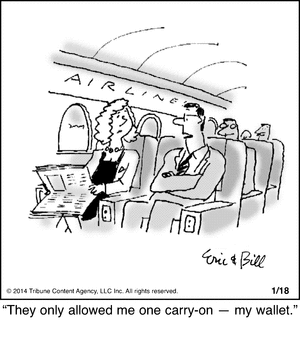
There has been little change to the basic cost of getting you from Point A to B.  All of these extra charges are there solely to generate additional revenue for the airlines - not to offer enhanced services.  For the airlines to suggest that this is a change desired by its customers is, at best, disingenuous, and at worst, an outright lie.
Fares have risen nearly 12 percent since 2009, an AP analysis shows.
When people say there is still plenty of competition: American, United, Delta, Southwest, Frontier, Jet Blue, Allegiant, Spirit, Alaska, let's look at all the cities with commercial air service and see what percentage are served by more than one or two airlines; what percentage have mainline flights; and what percentage are on a meaningful network. 
It's nice that Allegiant serves Portsmouth, NH (PSM) for example, but the only destinations are Orlando and Fort Myers/Punta Gorda. Allegiant doesn't sell connections, so PSM doesn't has meaningful, useful air service.  

(Business Class YUL-CDG in February.)
Is there any other industry where the main competitors' pricing looks like that and no-one bats an eye?

FlyersRights says an Airline Passenger Rights Act needs to be passed -
enforcing all-inclusive ticket pricing, basic travel requirements (i.e. seat standards, humane seat widths and row spacing, fair treatment when flights are cancelled and coverage of frequent flyer progams.)
The New Terrorism?
"Laughter Yoga" Coach Attempts To Make Travelers Giggle About Delays 
Last week, during a four-hour flight delay at JFK airport, a Laughter Yoga "Stylist and Coach" led a group of stressed passengers through a 20-minute "laughter meditation" session. 
A bystander took some video of the "surreal" event. One witness called the session "completely the last thing we ever want to see when we're stuck in a hermetically-sealed nightmare-place with strangers" and plead, "Dear god make the cackling stop."
 
NYC's Laughter Yoga  Coach,Francine Shore doing Laughter Yoga at LAN Airlines at JFK
NYC's Laughter Yoga Coach, Francine Shore, doing Laughter Yoga at LAN Airlines at JFK


Your Letters!


Dear FlyersRights:

I  have solved my unhappy experiences with flying within the US. My wife & I drove on our last 3 trips which were from the Midwest to DC, to New York & to Baltimore. While I loved to fly in the good old days, I now drive within the US.   Our next driving trip will be from Ohio to Florida, where we will take a foreign carrier to South America, and return the same way. 

Although partial, our boycott of America carriers is the only response we have for being mistreated by the airlines and the government's abusive TSA. 
Hope to hear that there are more people that drive when possible. And yes, we can do this as we are now retired. I am sorry for all the suffering public that has to put up with the current state of flying. 
EE 
Dear FlyersRights:
 
Complaint Re: United Air
I booked a round trip through Orbitz, Burbank to San Francisco 1/18/14-1/20/14.  When printing my boarding pass United printed a message flight oversold and did not print my seat but stated "See Agent". When I checked in the agent said my name would be called at the time of boarding.  As the groups were called I approached the gate agent and said I booked a seat and wanted to board. The agent had my printed boarding pass on her desk and I boarded. On the return trip I had to buy a $32.00 economy seat. The plane was not full.
B.V.
Dear FlyersRights:
We always get to the airport at least two (usually three) hours early and are rarely checking bags.  Even so, we have come perilously close to missing flights on several occasions (doors just being closed) because there was only one TSA agent checking tickets, a line that moved even slower because he was also handling a feeder line of First Class and priority fliers as well.  We're not talking small airports.  This happened to us at both Sea-Tac and Logan.  Is there anything you can do if you're about to miss your flight?  Or do you just have to miss it?  A much worse example of this follows:

Our next door neighbors with their three young children (5, 3, and infant) were flying from the Hartford to their home in San Diego on Monday, January 6.  They got to the airport hours early but by the time they stood in line to check baggage and to get a BVD (Boarding Verification Document) for the infant which has to be done at the ticket counter and got to the gate, Southwest said their tickets had been given away, although the door was still open.  
Southwest insisted that their computers were not sophisticated to know whether the family was already in the terminal although my neighbor protested how could they not?  They had checked bags and gotten the BVD for the baby which had to be done in person.  Further, they were told that the first available seats would not be until Thursday, Jan. 9 - three days hence.  On top of that, they were told they couldn't get their luggage back; it was already loaded.  

This genuinely surprised me as usually airlines will insist on removing luggage from a plane if the passenger doesn't fly.  (Is this a great way to blow up a plane - check your bag and arrive a hair too late?)  The family had to buy a three day supply of clothes to tide them over at considerable expense. 
Meanwhile, fearful that their luggage would be lost or stolen in San Diego if it sat there that long, they called a friend and gave him the ticket numbers and asked him to retrieve the bags.  When the friend got to the airport, a baggage office employee pointed him to a large stack of bags just sitting in the terminal where anyone could have walked off with them and told him to go find them.  The friend could have taken any bags he wanted.  This whole story makes me never want to fly again.
P.F.
Dear FlyersRights:
(In response to last week's newsletter on TSA's proposed "Service With A Smile" campaign)
I vote for a 100 IQ Pleaser (TSA greeter) at each position to verbalize requests to travelers - the 60 IQs can tell the 100 IQ what they want...
Also, a recliner disable button on the back of each seat... 
A.S.W.
  
Dear FlyersRights:
Perhaps you have already seen this in the Wall Street Journal.

No comment needed except what I noted to my call to Congressman Jim
Moran, "BDOs (Behavior Detection Officers) get five days of classroom training and two days of on-the-job training. They must pass a written test every year and be observed by a manager annually to stay certified. There is also recurrent training, TSA says."
W.W.

Pitch In and Help FlyersRights!
Volunteers are needed in all areas, and intern positions with stipends are available for students and recent graduates.  
Email Paul Hudson, (globetrotter1947[at]hotmail[dot]com.
Kate Hanni, founder of FlyersRights
Paul Hudson, president of FlyersRights
FlyersRights depends on tax-deductible contributions from those who share our commitment to airline passenger rights
You will be sent the latest FlyersRights publications and newsletters. You aren't merely supporting our mission, you become a part of FlyersRights. 
Thank you. 

 
or 
 
  FlyersRights 
4411 Bee Ridge Road 

Sarasota, FL 34233